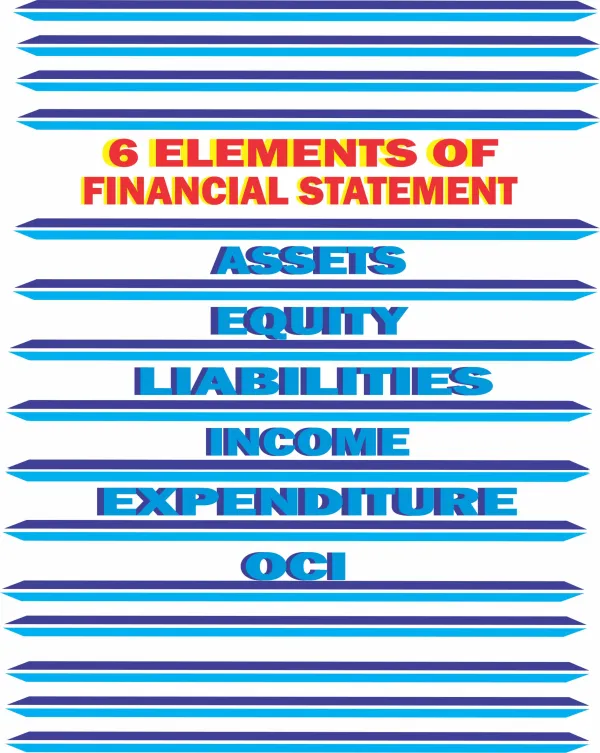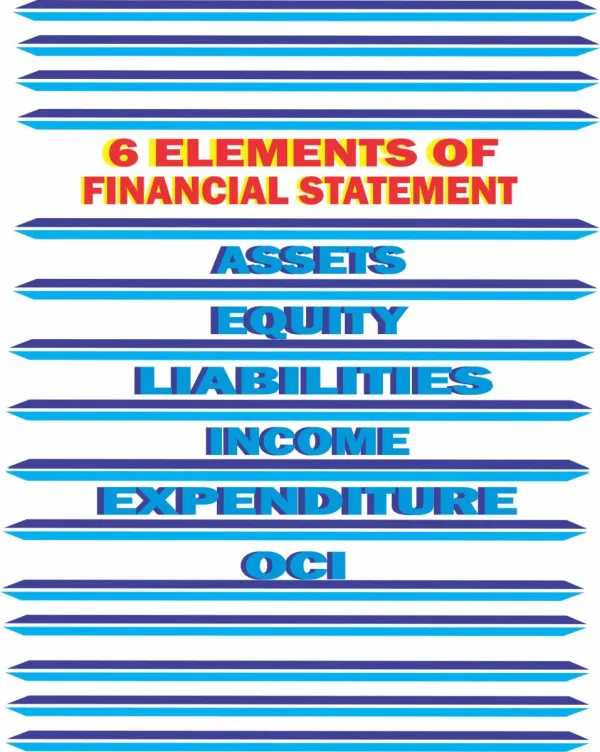
Six Elements of Financial Statements
The elements of financial statements are the fundamental components used in the preparation and presentation of financial reports. These elements are defined under frameworks such as the International Financial Reporting Standards (IFRS) and generally accepted accounting principles (GAAP).
1. Assets
- Definition:
Resources controlled by an entity as a result of past events, from which future economic benefits are expected to flow to the entity. Examples:
Cash, inventory, property, plant and equipment, trade receivables.2. Liabilities
- Definition:
Present obligations of an entity arising from past events, the settlement of which is expected to result in an outflow of resources embodying economic benefits. Examples:
Loans, trade payables, tax liabilities, accrued expenses.3. Equity
- Definition:
The residual interest in the assets of an entity after deducting all liabilities. It represents the owners’ interest in the entity. - Relationship:
Equity is determined as the difference between assets and liabilities. Examples:
Share capital, retained earnings, reserves.4. Income (Revenue)
- Definition:
Increases in economic benefits during an accounting period in the form of inflows or enhancements of assets, or decreases of liabilities, that result in increases in equity (excluding contributions from equity participants). Examples:
Sales revenue, service income, interest income, rental income.5. Expenses
- Definition:
Decreases in economic benefits during an accounting period in the form of outflows or depletions of assets, or incurrences of liabilities, that result in decreases in equity (excluding distributions to equity participants). Examples:
Staff costs, depreciation, cost of sales, utilities, rent.6. Other Comprehensive Income (OCI)
- Definition:
Items of income and expense that are not recognised in profit or loss as required or permitted by applicable accounting standards, but which affect equity. Examples:
Revaluation gains or losses on certain non-current assets, foreign currency translation differences, and fair value changes in specific financial instruments.