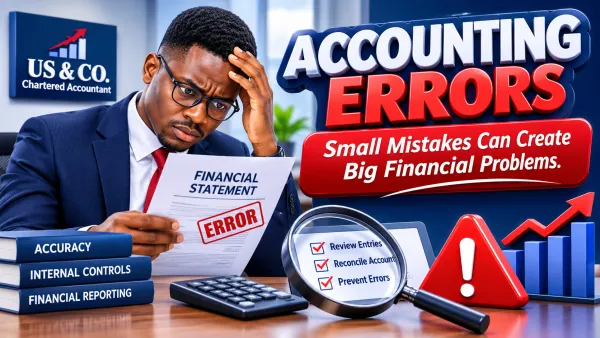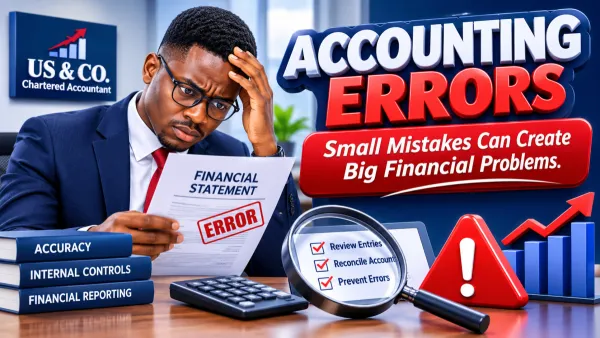
Accounting Errors: Common Mistakes That Can Distort Business Records
Accurate financial records are essential for every business. Management relies on accounting information to evaluate performance, monitor expenses, prepare financial statements and make important decisions.
However, accounting errors can occur at different stages of the financial recording process. If they are not identified and corrected, they may affect the reliability of financial information and lead to poor business decisions.
Understanding common accounting errors is therefore important for maintaining accurate financial records.
What Are Accounting Errors?
Accounting errors are unintentional mistakes made when recording, classifying, calculating or reporting financial transactions.
They may occur during bookkeeping, journal preparation, ledger posting or financial statement preparation.
Some errors affect the trial balance, while others may remain undetected because they do not cause the debit and credit totals to disagree.
Common Types of Accounting Errors
1. Error of Omission
This occurs when a financial transaction is completely or partially left out of the accounting records.
For example, a business may receive payment from a customer but fail to record the transaction.
2. Error of Commission
This occurs when a transaction is recorded in the wrong account of the same general class.
For example, a payment intended for one supplier may mistakenly be posted to another supplier's account.
3. Error of Principle
This occurs when a transaction is recorded in an account that violates the applicable accounting principle.
For example, recording the purchase of a long-term business asset as an ordinary operating expense when it should be recognised as an asset.
4. Error of Original Entry
This occurs when an incorrect amount is initially recorded in the accounting books and the same incorrect amount is posted to the relevant accounts.
5. Reversal of Entries
This happens when the correct accounts are used but their debit and credit positions are reversed.
6. Compensating Errors
These occur when two or more independent errors cancel out their numerical effects.
How Can Accounting Errors Affect Businesses?
- Financial statements may contain inaccurate information.
- Profit or loss may be incorrectly calculated.
- Assets and liabilities may be misstated.
- Tax calculations may be affected.
- Management decisions may be based on unreliable figures.
- Audit procedures may become more difficult.
How Can Businesses Prevent Accounting Errors?
1. Maintain Proper Documentation: Every transaction should have appropriate supporting evidence.
2. Review Accounting Entries: Transactions should be checked before posting.
3. Reconcile Financial Records: Bank accounts, receivables, payables and other relevant balances should be reconciled regularly.
4. Use Appropriate Accounting Software: Reliable accounting systems can support consistent recording and reduce manual calculation errors.
5. Separate Financial Responsibilities: Where practical, transaction preparation, approval and review should be assigned to different individuals.
6. Conduct Periodic Reviews: Management should review financial reports and investigate unusual balances.
Conclusion
Accounting errors can affect the accuracy of financial information and weaken business decision-making.
Although some errors may be unavoidable, organisations can reduce their occurrence through proper documentation, regular reconciliations, effective reviews and appropriate internal controls.
Reliable accounting records begin with accurate transaction processing.
US & CO. Chartered Accountant
Educational insights into accounting, auditing and financial reporting.