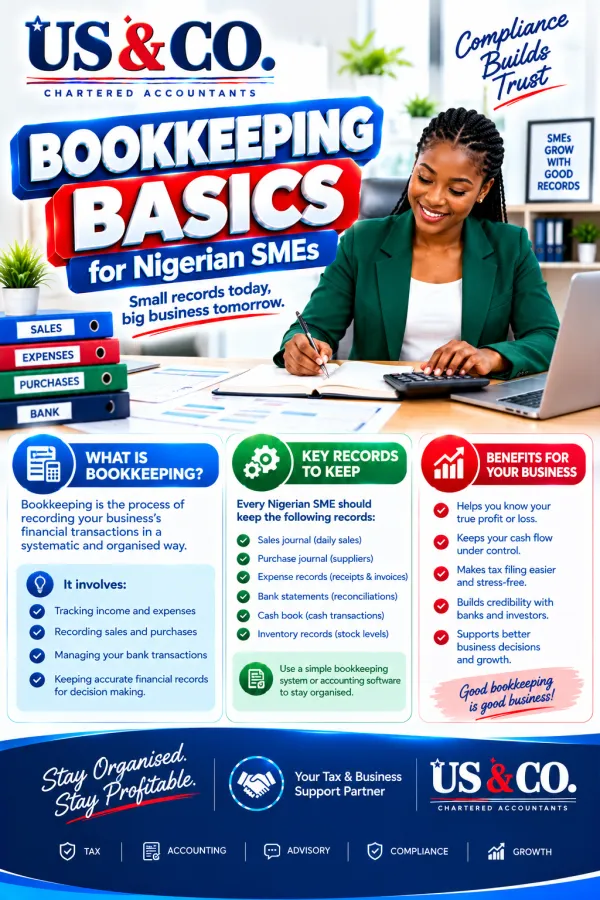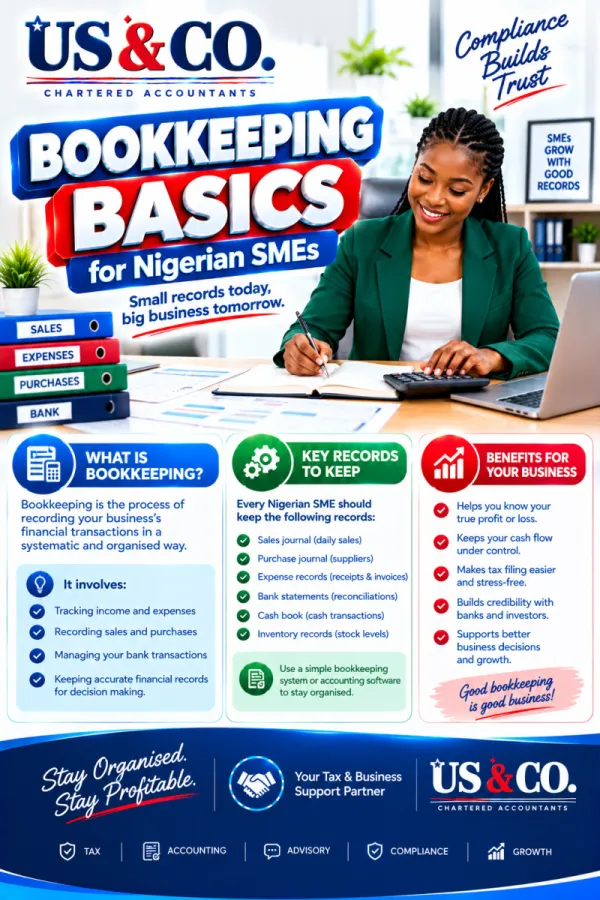
Every tax obligation a business has, VAT, PAYE, withholding tax, company income tax, depends on one underlying thing: accurate, complete books. Yet bookkeeping is often the most neglected part of running a small business in Nigeria, treated as an afterthought until a tax filing deadline or a loan application forces the issue. This article sets out the basics of what to record and why it matters.
How it works
Bookkeeping is the ongoing process of recording every financial transaction a business makes, sales, purchases, expenses, payments and receipts, in an organised and consistent way. It is distinct from accounting in the broader sense: bookkeeping is the recording of raw financial data; accounting involves interpreting, summarising and reporting on that data, often for tax computation or management decisions. Good accounting is only possible where good bookkeeping has already happened.
What every business should record
- Sales and income, with dates, amounts and customer details where relevant.
- Purchases and expenses, supported by invoices or receipts.
- Bank and POS transactions, reconciled regularly against your books.
- Payroll records, including gross pay, statutory deductions and net pay for each employee.
- Fixed asset purchases and disposals, supporting capital allowance claims.
- Tax filings and payment confirmations, for VAT, PAYE, withholding tax and company income tax.
- Loan and credit facility records, including repayment schedules.
How long to keep records
Published guidance generally recommends retaining most tax-related records for at least six years from the end of the relevant tax year, drawing on established self-assessment and audit practice, though Nigerian tax law does not appear to specify one single universal retention period across every tax type. Fixed asset records are often recommended to be kept for the life of the asset plus six years, and employment records for ten years or more. Where fraud is suspected, there is generally no time limit on record retention expectations. Confirm the applicable retention period for your specific records with a professional.
Why this matters to taxpayers
Weak bookkeeping does not simply create inconvenience at filing time. It directly affects the accuracy of every tax return a business files, and it determines whether a business can support its figures if a tax authority asks questions. A business that cannot produce supporting documentation for an expense risks having that expense disallowed, which increases its taxable profit and its tax bill, even where the underlying spending was genuine and legitimate.
Tax implications
- Undocumented expenses may be disallowed when computing taxable profit, increasing the tax liability even where the spending was real.
- Input VAT claims on invoices that do not meet documentation requirements may be disallowed, with associated penalties.
- Without proper books, a tax authority reviewing a business may estimate income based on total bank deposits, which can include personal funds mixed into a business account, inflating the assessed income.
- Records discarded before the end of the applicable retention period can leave a business unable to defend a position taken on an earlier tax return.
Step by step: setting up a basic bookkeeping routine
- Open a dedicated business bank account, separate from personal finances.
- Choose a simple, consistent method for recording transactions, whether a spreadsheet, a notebook ledger, or accounting software.
- Record every transaction as close to when it happens as possible, rather than relying on memory later.
- Keep physical or digital copies of every invoice and receipt, organised by month and category.
- Reconcile your bank and POS records against your books at least monthly.
- Set aside a fixed time each week or month for bookkeeping, rather than leaving it until tax season.
- Back up digital records regularly, and store physical records securely for the required retention period.
Why engage a professional consulting firm
- Setting up a bookkeeping system suited to your specific business, rather than adapting a generic template that does not fit.
- Periodic review to catch errors or gaps while they are still easy to correct.
- Translating raw bookkeeping records into accurate tax computations and filings.
- Advising on which records matter most for your specific tax obligations and industry.
Why every business should comply
Accurate, complete books are not only a tax requirement; they are the foundation for understanding how a business is actually performing. A business with reliable records can make better pricing, hiring and investment decisions, and is in a far stronger position if it ever needs financing, since lenders and investors rely heavily on a business's financial records.
Tips for better bookkeeping
- Record transactions daily or weekly, not in a single catch-up session at year-end.
- Keep business and personal spending strictly separate, even for small, incidental purchases.
- Photograph or scan paper receipts promptly, since physical copies fade and get lost.
- Review your books monthly against your bank statements, not only at tax filing time.
Relevant law
- Nigeria Tax Administration Act, 2025 (record-keeping and return filing requirements)
- Companies Income Tax Act and established self-assessment practice (retention standards)
Frequently asked questions
Is bookkeeping the same as accounting?
No. Bookkeeping is the recording of financial transactions; accounting involves interpreting and reporting on that recorded data, including for tax purposes.
How long should I keep my business records?
Published guidance generally recommends at least six years for most tax records, with longer periods for fixed assets and employment records. Confirm the applicable period for your specific records with a professional.
What happens if I cannot produce a receipt for a claimed expense?
The expense may be disallowed when your tax liability is computed, increasing the amount of tax due.
Do I need accounting software to keep proper books?
Not necessarily. A well-maintained spreadsheet or ledger can be sufficient for a small business, though software can reduce errors and save time as a business grows.
Where you need further assistance: You may contact US & CO. (Chartered Accountant), a professional tax consulting firm in Lagos, Nigeria.
📞 WhatsApp: 08056219998
📧 Email: info@usc.com.ng
🌐 Website: https://www.usc.com.ng
Footnote: This article is for general information only. It is not complete investment, tax or legal advice. Readers should consult a qualified professional and confirm current requirements with the relevant tax authority before making any investment or tax decision.