How Often Should a Business Reconcile Its Bank Account?
Bank reconciliation is one of the most important financial control procedures in any business. Whether you operate a small retail shop, a growing SME, or a large company in Nigeria, reconciling your bank account regularly helps ensure that your financial records accurately reflect your actual cash position.
Many business owners focus on generating sales and managing daily operations but overlook routine reconciliation of bank transactions. Over time, this can result in accounting errors, undetected fraud, missed income, duplicate payments, incorrect tax computations, and unreliable financial reports.
A disciplined bank reconciliation process supports informed business decisions, strengthens internal controls, and assists businesses in meeting their financial reporting and tax compliance obligations.
What Is Bank Reconciliation?
Bank reconciliation is the process of comparing the balances and transactions recorded in your accounting records with those appearing on your bank statement.
The objective is to identify and explain any differences, including:
- Outstanding cheques
- Deposits in transit
- Bank charges
- Direct debit transactions
- Standing orders
- Interest received
- Returned cheques
- Bank errors
- Recording mistakes within the accounting records
After all legitimate differences have been identified and necessary adjustments made, both records should reconcile.
How Often Should a Business Reconcile Its Bank Account?
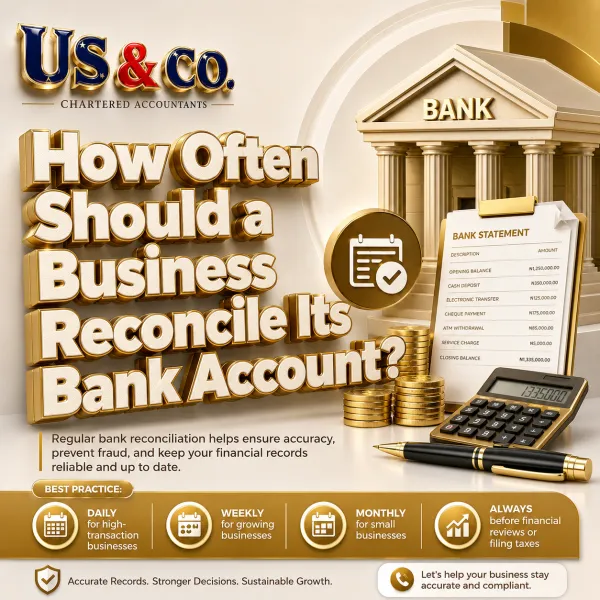
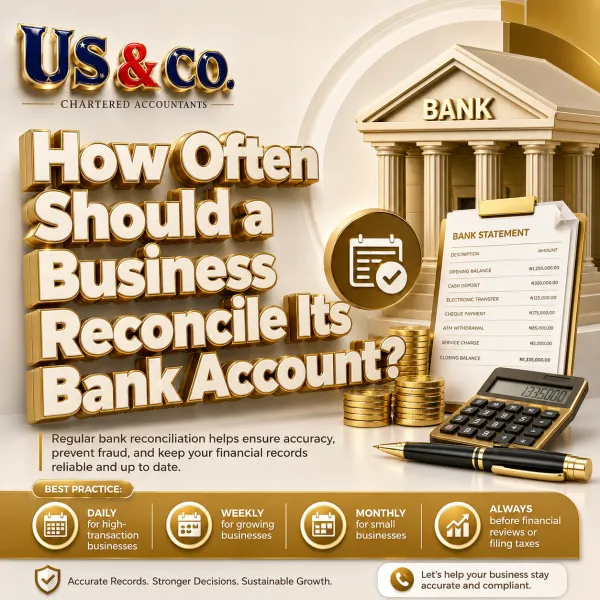
The appropriate frequency depends on the volume and complexity of business transactions.
Daily Reconciliation
Suitable for:
- Supermarkets
- Restaurants
- Hotels
- Fuel stations
- E-commerce businesses
- Companies with high daily transaction volumes
Daily reconciliation enables prompt identification of unusual transactions and maintains accurate cash records.
Weekly Reconciliation
Suitable for businesses with moderate transaction volumes.
Weekly reviews allow businesses to detect discrepancies before they accumulate and reduce month-end adjustments.
Monthly Reconciliation
At a minimum, every business should reconcile all bank accounts at least once every month, preferably immediately after receiving the monthly bank statement.
Monthly reconciliation supports:
- Accurate financial reporting
- Reliable management accounts
- Proper bookkeeping
- Tax compliance
- Audit readiness
Why Regular Bank Reconciliation Is Important
Regular reconciliation provides several practical benefits.
1. Detects Errors Early
Mistakes may occur through:
- Duplicate postings
- Omitted transactions
- Incorrect amounts
- Data entry errors
Early detection reduces the cost and complexity of corrections.
2. Helps Identify Unauthorised Transactions
Routine reconciliation may reveal:
- Unauthorised withdrawals
- Fraudulent transfers
- Incorrect bank charges
- Unknown direct debits
Prompt investigation can minimise financial losses.
3. Improves Cash Flow Management
Business owners can accurately determine:
- Available cash
- Outstanding payments
- Expected receipts
- Liquidity position
Reliable cash information supports operational planning.
4. Supports Accurate Financial Statements
Financial statements depend on accurate accounting records.
Reconciling bank accounts improves the reliability of:
- Cash balances
- Profit calculations
- Balance Sheet figures
- Cash Flow Statements
5. Simplifies External Audit
Businesses that maintain regular reconciliations generally have more organised accounting records.
This facilitates audit procedures by providing documented explanations for differences between accounting records and bank statements.
6. Assists Tax Compliance
Accurate accounting records contribute to the correct preparation of:
- Company Income Tax returns
- Value Added Tax (VAT) returns
- Withholding Tax schedules
- PAYE records
- Education Tax computations
- Development Levy calculations where applicable
Reliable accounting information reduces the likelihood of computational errors during tax filing.
Common Causes of Differences Between Bank Records and Accounting Records
Differences commonly arise from:
- Outstanding cheques
- Bank service charges
- Bank transfers
- Interest income
- Returned cheques
- Timing differences
- Duplicate transactions
- Manual posting errors
- Unrecorded receipts
- Bank processing delays
Regular reconciliation helps identify these items promptly.
Practical Tips for Effective Bank Reconciliation
Businesses should consider the following practices:
- Reconcile every bank account consistently.
- Maintain supporting documentation.
- Record transactions promptly.
- Separate accounting responsibilities where practical.
- Review unusual transactions immediately.
- Investigate long-outstanding reconciling items.
- Use accounting software where appropriate.
- Retain reconciliation schedules for future reference.
Why Nigerian Businesses Should Engage a Professional Consulting Firm for Tax Filing
Preparing and filing tax returns requires an understanding of applicable tax legislation, regulatory requirements, and supporting documentation.
Professional advisers can assist businesses by:
- Preparing tax computations based on accurate accounting records.
- Identifying computational or reporting errors before submission.
- Advising on statutory filing obligations and applicable deadlines.
- Maintaining supporting documentation for regulatory reviews.
- Assisting with responses to tax authority enquiries where appropriate.
- Helping businesses understand available tax reliefs, incentives, and credits under applicable laws.
- Supporting compliance with evolving tax regulations.
Professional engagement does not remove a taxpayer's legal responsibilities but can help businesses establish structured compliance processes.
Why Every Business Should Comply with Nigerian Tax Regulations
Tax compliance contributes to the orderly administration of business operations and supports statutory obligations.
Compliance helps businesses:
- Meet legal filing obligations.
- Reduce exposure to statutory penalties and interest arising from non-compliance.
- Maintain accurate financial records.
- Support applications that may require evidence of tax compliance.
- Demonstrate good corporate governance.
- Build confidence among lenders, investors, and business partners through transparent financial reporting.
Compliance should be viewed as an integral part of sound business management.
Tax Credits, Incentives and Planning Opportunities in Nigeria
Certain businesses may qualify for tax incentives or credits depending on applicable legislation and the nature of their operations.
Potential areas include:
- Capital allowance claims on qualifying assets.
- Loss relief carried forward in accordance with tax legislation.
- Reliefs available under applicable tax laws.
- Industry-specific incentives where provided by legislation.
- Tax treaty relief where applicable.
- Investment-related incentives introduced through relevant government policies.
- Proper documentation supporting deductible business expenses.
Businesses should ensure that any relief or incentive claimed is supported by legislation and adequate documentation.
Relevant Nigerian Tax Laws
Businesses should remain aware of key legislation governing taxation and financial compliance, including where applicable:
- Nigeria Tax Act, 2025
- Nigeria Tax Administration Act, 2025
- Nigeria Revenue Service (Establishment) Act, 2025
- Joint Revenue Board (Establishment) Act, 2025
- Companies and Allied Matters Act (CAMA)
- Financial Reporting Council of Nigeria Act
- Value Added Tax provisions applicable under current law
- Applicable regulations and public notices issued by relevant tax authorities
Because tax legislation may be amended, businesses should keep abreast of current requirements and official guidance.
Building Strong Financial Controls
Bank reconciliation should not be viewed as merely an accounting routine.
It is a fundamental internal control that contributes to:
- Reliable financial reporting
- Better cash management
- Timely detection of errors
- Regulatory compliance
- Improved decision-making
- Organised accounting records
- Effective tax administration
Businesses that maintain regular reconciliations are generally better positioned to produce accurate financial information and meet statutory obligations.
Where appropriate, businesses may seek guidance from qualified accounting and tax professionals, including US & CO. (Chartered Accountant), for assistance with accounting systems, financial reporting, tax compliance, and related professional services.
Contact Information
Where professional assistance is required, you may contact:
US & CO. (Chartered Accountant)
📞 WhatsApp: 08056219998
📧 Email: info@usc.com.ng
🌐 Website: https://www.usc.com.ng
Frequently Asked Questions (FAQs)
1. What is bank reconciliation?
Bank reconciliation is the process of comparing a business's accounting records with its bank statement to identify and explain any differences.
2. How often should bank reconciliation be performed?
Businesses with high transaction volumes may reconcile daily or weekly, while all businesses should reconcile their bank accounts at least monthly.
3. Why is bank reconciliation important for tax compliance?
Accurate reconciliations help ensure that accounting records used for tax computations are complete and reliable, reducing the likelihood of reporting errors.
4. Can accounting software replace bank reconciliation?
Accounting software can automate parts of the process, but reconciliations should still be reviewed to confirm accuracy and investigate any differences.
5. Why should businesses engage qualified professionals for tax compliance?
Qualified professionals can assist businesses in understanding applicable tax requirements, preparing accurate tax computations, maintaining appropriate documentation, and supporting compliance with relevant tax laws.
6. Can a business claim available tax incentives automatically?
No. Businesses should confirm that they satisfy the relevant legal conditions and maintain adequate supporting documentation before claiming any relief, incentive, or tax credit.
7. What records should businesses retain for reconciliation?
Businesses should retain bank statements, payment vouchers, receipts, invoices, deposit slips, accounting records, and reconciliation schedules as part of their financial documentation.
8. Does regular bank reconciliation help prevent fraud?
Regular reconciliation can assist in identifying unusual or unauthorised transactions promptly, allowing businesses to investigate and take appropriate action.