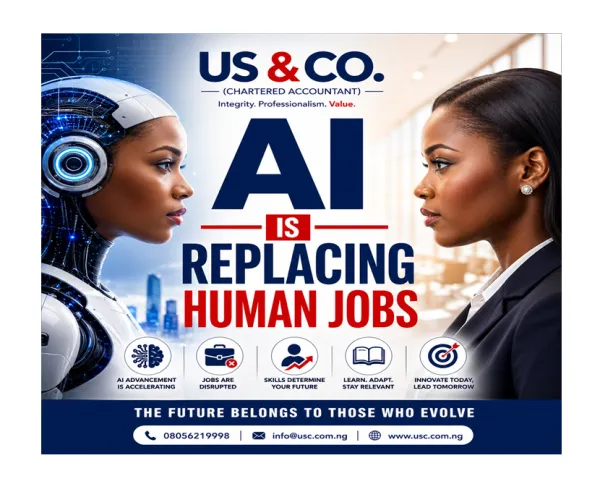
WHY AI CAN NOT REPLACE MY JOB
Artificial Intelligence (AI) is transforming business operations across industries, including accounting, auditing, taxation, compliance, and financial reporting. AI tools can assist with automation, data analysis, reporting processes, document review, and workflow efficiency. However, despite the advancement of technology, professional judgment, ethical responsibility, human reasoning, and regulatory interpretation remain essential in professional practice.
At US & CO. (Chartered Accountant), technology is viewed as a professional support tool rather than a replacement for qualified professionals. Our firm continuously trains staff on the responsible use of AI tools to improve efficiency, documentation processes, compliance monitoring, reporting quality, and client service delivery.
My Reasons Why AI Cannot Replace My Job
1. AI Is Artificial, I Am Natural
AI operates based on programmed algorithms, stored data, and generated patterns. Human professionals apply reasoning, emotional intelligence, ethics, communication skills, and professional skepticism in real-life situations.
In accounting and taxation practice, clients often require interpretation, advisory support, risk evaluation, negotiation, and professional judgment that cannot be fully automated.
Human professionals understand business realities, economic conditions, industry-specific challenges, and regulatory expectations in ways that go beyond machine-generated outputs.
2. I Have Learnt AI, AI Never Studied Me
AI systems are created and trained by humans. Professionals learn how to use technology responsibly and understand when human intervention is necessary.
At US & CO. (Chartered Accountant), continuous learning and professional development remain important aspects of our operations. Staff members are encouraged to understand emerging technologies while maintaining professional ethics, confidentiality, accountability, and regulatory compliance.
AI can process information, but professionals determine whether the information is accurate, applicable, ethical, and compliant with relevant laws and standards.
3. I Understand AI Tools
Understanding AI tools means knowing both their strengths and limitations.
AI tools may assist with:
- Data organization
- Document drafting
- Financial analysis support
- Workflow automation
- Research assistance
- Reporting efficiency
However, AI-generated information still requires professional review and validation.
In taxation and accounting practice, inaccurate figures, incomplete interpretations, or incorrect filings may expose businesses to penalties, regulatory disputes, and compliance risks. Human supervision remains necessary to ensure accuracy and accountability.
4. I Use AI Tools Responsibly
Responsible use of AI involves:
- Maintaining confidentiality
- Verifying information accuracy
- Applying professional judgment
- Avoiding overreliance on automated outputs
- Ensuring compliance with applicable laws and ethical obligations
Professional accountants and tax consultants are accountable for the final outcome of their work. AI may support efficiency, but responsibility still rests with the professional handling the engagement.
This is particularly important in tax compliance, audit reporting, and financial advisory services where regulatory obligations must be properly interpreted and applied.
5. I Apply AI to Improve the Quality and Efficiency of My Work
AI can improve productivity when used responsibly.
At US & CO. (Chartered Accountant), AI tools may support:
- Faster document processing
- Improved workflow management
- Reporting assistance
- Data review procedures
- Administrative efficiency
- Research support
However, final professional review, regulatory interpretation, compliance assessment, and client advisory remain human responsibilities.
Technology works best when combined with qualified professional oversight.
How AI Supports Accounting and Tax Practice
AI tools can support:
- Financial reporting processes
- Tax documentation preparation
- Data reconciliation
- Compliance tracking
- Risk identification
- Internal workflow management
Despite these benefits, businesses still require qualified professionals to:
- Interpret tax laws
- Apply accounting standards
- Manage audits
- Handle regulatory communication
- Review compliance obligations
- Provide business advisory support
Step-by-Step Guide on How to File Accounts on REV360
REV360 is part of Nigeria’s evolving digital tax administration system designed to improve tax processes and taxpayer interactions.
Step 1: Create or Access Your REV360 Account
Visit the official tax platform and log in using your registered business credentials and Tax Identification Number (TIN).
Step 2: Update Business Information
Ensure that:
- Company details are accurate
- Email and contact information are updated
- Tax office information is correct
- Directors and business activities are properly reflected
Step 3: Prepare Financial Statements
Compile:
- Statement of financial position
- Profit and loss account
- Supporting schedules
- Tax computation
- Capital allowance schedules where applicable
Step 4: Upload Required Documents
Businesses may be required to upload:
- Financial statements
- Tax computation reports
- Audit reports where applicable
- Supporting schedules and documentation
Step 5: Review Tax Computation
Carefully verify:
- Turnover figures
- Allowable expenses
- VAT obligations
- Capital allowances
- Applicable tax rates
- Filing periods
Step 6: Submit Returns
After review and confirmation, submit the returns electronically through the platform.
Step 7: Generate Acknowledgement
Download and keep evidence of submission, receipts, and acknowledgements for record purposes.
Why REV360 and Digital Tax Compliance Matter to Taxpayers
Digital tax systems support:
- Faster processing
- Improved transparency
- Better record management
- Easier compliance monitoring
- Electronic documentation storage
- Reduced paperwork challenges
However, businesses should ensure proper professional guidance during filing to avoid:
- Incorrect tax computations
- Incomplete submissions
- Filing errors
- Missed deadlines
- Regulatory penalties
Why Businesses Should Use Professional Consulting Firms
Using professional accounting and tax consultants may help businesses:
- Maintain accurate records
- Monitor statutory deadlines
- Improve compliance processes
- Reduce filing errors
- Understand tax obligations
- Identify lawful tax planning opportunities
- Maintain proper documentation for audits and regulatory reviews
Professional oversight remains important because tax regulations continue to evolve.
Why Every Business Should Comply With Tax Regulations
Tax compliance supports:
- Lawful business operations
- Corporate credibility
- Access to contracts and financing opportunities
- Reduced exposure to penalties and interest charges
- Better financial governance
Relevant Nigerian tax laws may include:
- Companies Income Tax Act (CITA)
- Personal Income Tax Act (PITA)
- Value Added Tax (VAT) Act
- Federal Inland Revenue Service (Establishment) Act
- Capital Gains Tax Act
- Relevant financial reporting regulations
Tax Credit Opportunities and Compliance Tips in Nigeria
Businesses should:
- Maintain proper accounting records
- File returns accurately and timely
- Monitor allowable deductions and expenses
- Review industry-specific incentives where applicable
- Maintain VAT compliance records
- Properly document payroll and withholding tax obligations
Professional guidance may help businesses identify applicable incentives and avoid compliance gaps.
Human Expertise Still Matters
Technology will continue to evolve, but human expertise remains important in professional practice.
AI can process information, but professionals provide:
- Ethical judgment
- Accountability
- Interpretation
- Communication
- Decision-making
- Regulatory understanding
- Client relationship management
The future of accounting and taxation is not simply AI versus humans. The future is professionals using technology responsibly to improve efficiency, compliance, and service quality.
At US & CO. (Chartered Accountant), technology and professional expertise are applied together to support businesses in accounting, auditing, taxation, regulatory compliance, and business advisory processes.
Where professional assistance is required:
📞 WhatsApp: 08056219998
📧 Email: info@usc.com.ng
🌐 Website: https://www.usc.com.ng/
Frequently Asked Questions (FAQ)
1. Can AI replace accountants and tax consultants?
AI can support automation and efficiency, but professional judgment, ethics, compliance interpretation, and advisory functions still require human expertise.
2. Why should businesses use professional tax consultants?
Professional consultants may help reduce filing errors, improve compliance processes, and support proper regulatory reporting.
3. What is REV360?
REV360 is part of Nigeria’s evolving digital tax administration framework designed to support electronic tax processes and taxpayer interaction.
4. Why is tax compliance important?
Compliance supports lawful business operations, improves credibility, and reduces regulatory risks and penalties.
5. Can AI improve accounting operations?
Yes. AI may support efficiency, reporting assistance, workflow management, and data analysis when used responsibly under professional supervision.