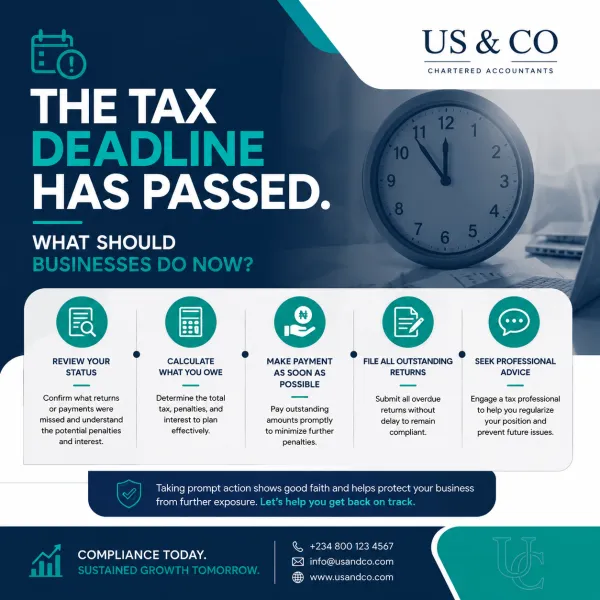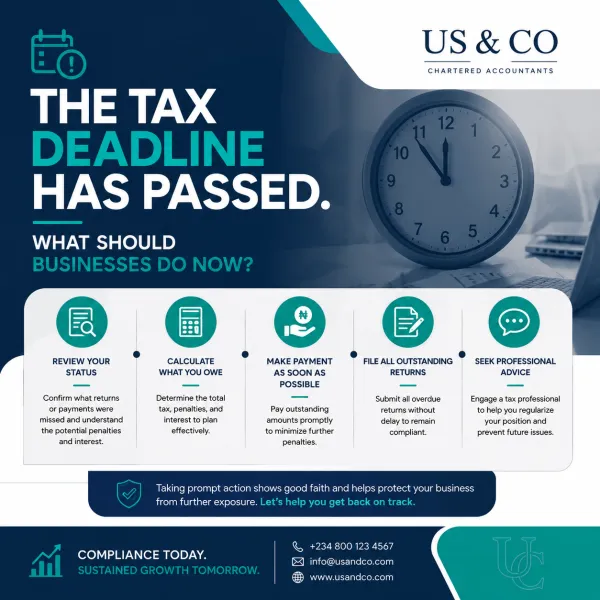
THE TAX DEADLINE HAS PASSED. WHAT SHOULD BUSINESSES DO NOW?
A Practical Guide for Nigerian Businesses After a Tax Compliance Deadline
Tax deadlines are easy to notice when they are approaching.
The more important question is what happens after the deadline has passed.
For Nigerian businesses, this question has become increasingly relevant as tax administration continues to move toward digital processes, electronic invoicing, stronger data integration and closer compliance monitoring.
For example, the Nigeria Revenue Service (NRS) set 31 July 2026 as the deadline for large taxpayers to fully adopt the National E-Invoicing and Electronic Fiscal System (EFS), including the required onboarding, integration, testing and commencement of invoice transmission. The NRS also indicated that compliance monitoring had commenced.
But missing a deadline does not mean a business should stop taking action.
It means the business should assess its position, correct what can be corrected, regularise outstanding obligations and establish controls to prevent repeated non-compliance.
What Should a Business Do After a Tax Deadline Has Passed?
The first step is not panic.
The first step is fact-finding.
A business should establish:
- Which tax obligation was due?
- What was the applicable filing or payment deadline?
- Was the return filed?
- Was the tax liability paid?
- Was the filing complete and accurate?
- Were supporting documents retained?
- Were there errors or omissions?
- Does the business have any outstanding correspondence from the tax authority?
- Are there penalties, interest or other consequences applicable under the relevant law?
- Does the business have other upcoming compliance deadlines?
A missed deadline should therefore trigger a compliance review, not simply an attempt to submit something as quickly as possible.
1. Do Not Assume That a Missed Deadline Means the Matter Is Closed
One common mistake is to treat a missed deadline as a reason to postpone action until the next filing period.
That can increase the compliance exposure.
Where a return or payment is outstanding, the business should determine the appropriate procedure for regularisation under the applicable tax law and administrative framework.
Depending on the circumstances, this may involve filing the outstanding return, paying the relevant liability, addressing applicable penalties or interest, responding to a notice, correcting an error or providing additional information.
The precise treatment depends on the tax involved, the taxpayer's circumstances and the applicable legislation.
The correct response to a missed deadline is therefore prompt assessment and appropriate regularisation.
2. Review Every Tax Obligation — Not Just the One That Was Missed
A business that discovers one compliance problem should not automatically assume that everything else is in order.
A wider review may identify:
- Company Income Tax obligations
- Value Added Tax obligations
- Withholding Tax obligations
- PAYE obligations
- Capital Gains Tax considerations
- Education-related tax obligations where applicable
- Sector-specific taxes or levies
- Transfer Pricing obligations where applicable
- Tax registration and identification requirements
- Annual tax returns
- Tax clearance documentation
- Applicable electronic invoicing requirements
- Other statutory filings relevant to the business
The exact obligations depend on the nature, structure, activities and circumstances of each taxpayer.
This is why tax compliance should be treated as a system, rather than as a series of isolated deadlines.
3. Reconcile Your Accounting Records Before Filing
A tax return should not be prepared simply by looking at the bank balance.
Before filing or correcting a return, the business should reconcile relevant financial information.
This may include comparing:
Sales records → Invoices → Bank receipts → Accounting records → Tax computations → Tax returns
Differences between these records may indicate:
- omitted transactions;
- duplicated entries;
- incorrect tax treatment;
- timing differences;
- unrecorded expenses;
- incorrect classifications;
- unreconciled bank transactions; or
- weaknesses in the accounting process.
A business may therefore discover that the real problem was not the missed deadline itself, but weaknesses in the records supporting the return.
4. Review Your Invoices and Digital Records
Nigeria's tax administration is becoming increasingly digital.
The recent e-invoicing implementation for large taxpayers illustrates this direction. The NRS required affected large taxpayers to complete onboarding, system integration and testing and commence transmission of invoices through the prescribed electronic system.
This means businesses should increasingly ask a practical question:
Can our financial records support what we report to the tax authority?
Businesses should review:
- customer invoices;
- supplier invoices;
- credit notes;
- debit notes;
- sales records;
- purchase records;
- bank transactions;
- accounting software;
- tax records; and
- supporting documentation.
The objective is not simply to have more documents.
The objective is to have consistent, traceable and supportable records.
5. Do Not File an Incorrect Return Simply Because the Deadline Has Passed
Pressure created by a missed deadline can lead to another problem: submitting inaccurate information merely to meet a filing requirement.
That approach can create additional exposure.
A tax return should be prepared using reasonable care, appropriate records and the applicable tax rules.
If information is incomplete, the business should establish what can properly be reported and what further documentation is required.
Professional tax compliance is not about making numbers appear favourable.
It is about ensuring that the information submitted is accurate, supportable and consistent with the applicable law.
6. Check Whether You Have Tax Credits, Reliefs or Other Lawful Opportunities
Tax compliance does not mean simply calculating what a business owes.
Businesses should also understand whether they are entitled to lawful tax reliefs, credits, deductions, incentives or other provisions available under the applicable tax legislation.
Depending on the business and the relevant law, these may relate to matters such as:
- qualifying business expenditure;
- allowable deductions;
- capital allowances;
- withholding tax credits;
- applicable tax credits;
- incentives available to qualifying sectors or activities;
- investment-related provisions;
- losses that may be available for utilisation under applicable rules; and
- other statutory reliefs or exemptions.
However, a business should not claim a tax benefit merely because it appears financially attractive.
The question should always be:
Does the business satisfy the legal conditions for the benefit?
Proper documentation is also important.
A legitimate tax opportunity without adequate supporting evidence can become a compliance issue.
7. Understand the Difference Between Tax Planning and Tax Avoidance
Tax planning involves organising legitimate business activities and transactions with proper consideration of their tax consequences.
It does not mean concealing income, creating false expenses, manipulating records or submitting misleading information.
A responsible tax planning process asks:
- What does the law provide?
- Does the business qualify?
- What documentation is required?
- What conditions must be satisfied?
- What are the commercial consequences?
- What are the reporting requirements?
The objective should be lawful and transparent tax efficiency, not artificial arrangements designed to misrepresent the underlying transaction.
8. Why Should Businesses Use a Professional Tax Consulting Firm?
Tax laws and administrative requirements can involve technical rules, deadlines, calculations, documentation and digital filing procedures.
A professional tax adviser can assist a business by bringing structured review and professional judgement to the compliance process.
This can be particularly useful where a business:
- has multiple sources of income;
- operates across different locations;
- has employees;
- engages contractors;
- makes significant purchases;
- imports or exports;
- undertakes related-party transactions;
- operates in a regulated sector;
- has received a tax notice;
- has outstanding returns;
- has undergone significant growth; or
- is transitioning to new digital tax processes.
A professional review can help identify:
1. Filing errors
Errors in classification, calculations or reporting can be identified before they become larger problems.
2. Missing obligations
A business may be complying with one tax while overlooking another obligation.
3. Documentation weaknesses
A professional review can identify whether transactions are adequately supported.
4. Reconciliation differences
Accounting records, bank transactions, invoices and tax returns can be compared.
5. Applicable tax opportunities
Potential deductions, credits, allowances or incentives can be considered where the legal conditions are satisfied.
6. Compliance calendar gaps
Future filing and payment obligations can be mapped to reduce the risk of repeated missed deadlines.
7. Professional representation
Where appropriate and authorised, a professional adviser may assist in communicating with the relevant tax authority and responding to compliance matters.
The purpose is not to transfer responsibility away from the business.
Management remains responsible for its records, decisions and compliance.
Professional advice provides an additional layer of technical review and support.
9. Why Every Business Should Take Tax Compliance Seriously
Tax compliance is more than paying money to government.
It is part of responsible business administration.
A properly maintained tax record can support:
Business credibility
Accurate records can provide evidence of responsible financial administration.
Better financial decision-making
When tax liabilities are properly recognised, management has a clearer picture of the business's financial position.
Reduced compliance exposure
Timely filing, accurate reporting and appropriate documentation can reduce avoidable compliance problems.
Better preparation for financing
Banks, investors and other stakeholders may require reliable financial and tax information when assessing a business.
Improved transaction readiness
Businesses seeking to enter partnerships, contracts, investments or other significant transactions may need properly organised financial and compliance records.
Business continuity
Tax problems can consume management time and resources.
A structured compliance system helps management focus on operating the business rather than repeatedly resolving preventable administrative problems.
10. What About a Business That Has Already Missed the Deadline?
There is no single answer for every taxpayer.
The appropriate response depends on:
- the type of tax;
- the taxpayer's classification;
- the relevant reporting period;
- whether a return was filed;
- whether payment was made;
- whether the business has received a notice;
- the reason for the delay;
- the applicable legislation; and
- the current position of the taxpayer's records.
The sensible approach is to establish the facts before taking corrective action.
Do not ignore the matter.
Do not create artificial records.
Do not backdate documents improperly.
Do not submit figures that cannot be supported.
Instead:
Review → Reconcile → Determine the obligation → Correct the records → File appropriately → Pay applicable liabilities → Retain evidence → Monitor future deadlines.
11. A Practical Tax Compliance Checklist for Nigerian Businesses
Business owners can use the following checklist after a tax deadline:
☐ Identify the missed obligation.
☐ Confirm the applicable deadline.
☐ Determine whether the return was filed.
☐ Determine whether payment was made.
☐ Review the accounting records.
☐ Reconcile bank transactions.
☐ Reconcile sales with invoices.
☐ Review purchases and supporting documents.
☐ Check withholding tax records and credits where applicable.
☐ Review VAT records where applicable.
☐ Review PAYE obligations where applicable.
☐ Check whether any tax notices have been received.
☐ Determine whether penalties or interest may apply.
☐ Review available lawful deductions, credits, allowances or incentives.
☐ Correct identifiable accounting errors.
☐ Obtain professional advice where the position is complex.
☐ Regularise outstanding obligations.
☐ Establish a tax compliance calendar for future periods.
12. What Should Businesses Do Before the Next Deadline?
The best time to improve tax compliance is not the day before a deadline.
Businesses should establish a recurring compliance process.
A useful monthly routine can include:
Week 1: Update accounting records.
Week 2: Reconcile bank and sales records.
Week 3: Review tax computations and supporting documents.
Week 4: Confirm upcoming filing and payment obligations.
This simple structure can help convert tax compliance from an emergency exercise into an ordinary business process.
The Bigger Lesson: A Tax Deadline Is Only One Part of Compliance
The passing of a deadline should not be viewed in isolation.
Nigeria's tax environment is developing toward greater digitalisation and increased use of electronic systems and data. The July 2026 e-invoicing requirement for large taxpayers is one example of this direction.
For businesses, this creates a practical responsibility:
Your accounting records, invoices, payments and tax filings should increasingly tell the same story.
That is why tax compliance should not be left entirely to the final days of a filing period.
A business that maintains accurate books, reconciles its records regularly, understands its obligations and seeks professional advice when necessary is better positioned to respond to regulatory changes.
How US & CO. (Chartered Accountant) Can Assist
US & CO. (Chartered Accountant) provides professional accounting and tax advisory services to businesses in Nigeria.
Where a business has missed a tax deadline, identified discrepancies in its records, received a tax notice or needs assistance reviewing its tax compliance position, professional advice can help establish the facts and determine the appropriate next steps under the applicable rules.
The appropriate course of action will depend on the individual taxpayer's circumstances and the relevant legislation.
Where you need further assistance, you may contact a professional tax consulting firm in Lagos, Nigeria:
📞 WhatsApp: 08056219998
📧 Email: info@usc.com.ng
🌐 Website: www.usc.com.ng
Frequently Asked Questions (FAQs)
1. What should I do if my business missed a tax deadline?
First, identify the specific tax obligation and reporting period. Then review whether the return and payment were completed, assess the reason for the delay, reconcile the underlying records and determine the appropriate regularisation procedure.
2. Does missing a tax deadline automatically mean my business is liable for a penalty?
The consequences depend on the specific tax, applicable legislation, taxpayer category and circumstances. Businesses should determine the applicable rules rather than assuming that every missed deadline has the same consequence.
3. Can I still file a tax return after the deadline?
In many circumstances, outstanding returns can still be addressed after the original deadline. The appropriate procedure and any applicable consequences depend on the relevant tax law and the taxpayer's circumstances.
4. Should I amend my tax return if I discover an error?
If an error has been identified, the business should determine the appropriate correction or amendment procedure under the applicable rules. Professional advice may be appropriate where the error is material or the treatment is uncertain.
5. Can a professional tax consultant help with a missed deadline?
Yes. A professional tax consultant can assist with reviewing records, identifying outstanding obligations, reconciling information, preparing appropriate filings and advising on compliance steps, subject to the applicable law and professional requirements.
6. What tax records should a Nigerian business keep?
Businesses should maintain appropriate accounting records, invoices, receipts, bank records, payroll records, tax filings, payment evidence and other supporting documents relevant to their transactions and tax obligations. The specific retention requirements depend on the applicable law.
7. Can businesses claim tax credits or deductions after discovering a missed deadline?
Potentially, where the taxpayer satisfies the legal requirements. However, eligibility, timing, documentation and the method of claiming the relevant credit or deduction should be checked under the applicable legislation.
8. Is tax compliance only the responsibility of the accountant?
No. Business management remains responsible for its business records, decisions and statutory obligations. Accountants and professional advisers can provide technical assistance, review and advice, but professional engagement does not remove management's responsibility.
9. Why is reconciliation important before filing taxes?
Reconciliation helps identify differences between accounting records, bank transactions, invoices and tax computations. It can help reduce errors and provide a clearer basis for preparing accurate returns.
10. What should a business do differently before the next tax deadline?
Start earlier. Maintain accounting records regularly, reconcile transactions, retain supporting documents, monitor tax obligations and seek professional advice where technical issues arise. Tax compliance works better as a continuous business process than as a last-minute exercise.