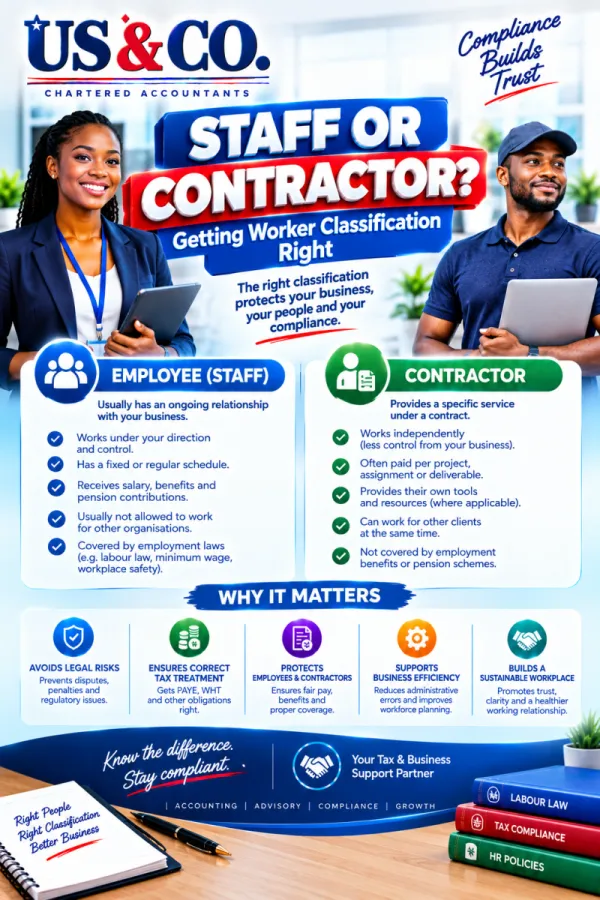
How a business labels a working relationship on paper is not necessarily how a tax authority will treat it. Whether someone is genuinely an independent contractor or, in substance, an employee has real consequences for PAYE, pension, NSITF and other statutory obligations. This article explains how classification is assessed in Nigeria and what businesses should check.
How it works
Nigerian tax treatment generally distinguishes between a contract of service (an employment relationship) and a contract for services (an independent contracting relationship). The label a business gives the relationship in writing is not the deciding factor. Nigerian courts and tax authorities apply a substance-over-form approach: if the actual working relationship resembles employment, it will generally be treated as employment for tax and pension purposes, regardless of what the engagement letter or contract calls it.
Factors typically weighed
No single factor is decisive on its own; the overall pattern of the relationship is assessed. Commonly considered factors include:
- Control — who directs how, when and where the work is carried out.
- Integration — whether the work is a core, ongoing part of the business or a discrete, defined project.
- Tools and equipment — whether the business or the worker supplies what is needed to do the work.
- Exclusivity — whether the worker is free to work for other clients or serves only the one business.
- Financial risk — whether the worker can profit or lose on the engagement, or simply receives a fixed, regular wage regardless of outcome.
- Substitution — whether the worker must personally perform the work, or may send someone else in their place.
- Continuity — whether the relationship is open-ended and ongoing, or has a clearly defined scope and end date.
- Payment structure — a regular salary paid on a fixed schedule points toward employment; payment per invoice or per milestone points toward contracting.
Why this matters to taxpayers
A business that misclassifies an employee as a contractor is not simply making an administrative choice; it is potentially understating its statutory obligations. If a tax or pension authority later determines that the relationship was, in substance, employment, the business can face a reassessment covering the full period the relationship existed, not merely going forward.
Tax implications
- PAYE. If a worker treated as a contractor is reclassified as an employee, the business may be reassessed for unpaid or under-deducted PAYE across the relevant period.
- Pension. Employee pension contributions (8% employee, 10% employer, on the pensionable pay base) may be reassessed where a worker is found to have been, in substance, an employee rather than a contractor.
- NSITF and ITF. These are employer-only statutory obligations tied to employment. A reclassification can result in back-dated employer contributions being assessed.
- Interest and penalties. Published guidance indicates that reassessments of this kind generally carry interest and penalties for the full period involved, with the employer, not the worker, bearing the cost. Specific rates were not available in the sources reviewed for this article and should be confirmed directly.
- Withholding tax. Contractors typically have withholding tax deducted at source on fees paid (reported at 5% for consultancy services in earlier guidance). How this interacts with a subsequent reclassification to employee status is a detail worth confirming directly, since the mechanics of each tax differ.
Step by step: how to review your worker classifications
- List every individual providing services to your business who is not on formal payroll.
- Assess each relationship against the classification factors above, rather than relying solely on the title or contract wording used.
- Flag any relationship with employment-like characteristics — fixed hours, exclusive engagement, supplied tools, ongoing and indefinite duration.
- Review the payment structure for each worker, noting whether it resembles a salary or genuine invoicing for defined deliverables.
- Correct classification going forward where a review indicates a mismatch, rather than leaving it unaddressed.
- Document the basis for each classification decision, in case it is later queried.
- Review classifications periodically, since a relationship that began as genuine contracting can evolve into something closer to employment over time.
Why engage a professional consulting firm
- Objective assessment of borderline relationships, where a business owner's own view may be influenced by cost considerations rather than the legal substance of the relationship.
- Exposure quantification, estimating what a potential reassessment could look like before it becomes a live issue.
- Correction planning, where misclassification is identified, to bring a relationship into compliance in an orderly way.
- Documentation support, building a clear, defensible record for each worker's classification.
Why every business should comply
Correct worker classification protects a business from a reassessment that can cover an extended back period, along with accumulated interest and penalties. It also ensures workers who are, in substance, employees receive the statutory protections and benefits, such as pension contributions, that come with that status.
Tips and points to watch
- Review classification at the point of engagement, not only when a dispute or audit arises.
- Be cautious with long-running "contractor" relationships that have gradually taken on employment-like characteristics.
- Keep engagement letters and contracts aligned with the actual working arrangement, rather than aspirational wording that does not reflect practice.
- Treat classification as a recurring review item, not a one-time decision made when a worker first joins.
Relevant law
- Nigeria Tax Act, 2025 and Nigeria Tax Administration Act, 2025 (PAYE and withholding tax treatment)
- Pension Reform Act, 2014 (pension obligations tied to employment status)
- Employees' Compensation Act, 2010 (NSITF obligations)
- General common-law principles distinguishing a contract of service from a contract for services, as applied by Nigerian courts and tax authorities
Frequently asked questions
Does the title in a contract determine whether someone is an employee or a contractor? No. Tax authorities and courts generally look at the substance of the working relationship, not the label used in the contract.
What is the biggest risk of misclassifying an employee as a contractor? A potential reassessment for unpaid PAYE, pension and other statutory contributions across the period the relationship existed, along with interest and penalties.
Who bears the cost if a contractor is reclassified as an employee? Published guidance indicates the employer generally bears the cost of a reassessment, not the worker.
Can a long-term contractor relationship become an employment relationship over time? Yes. A relationship that began as genuine contracting can take on employment-like characteristics as it evolves, which is why periodic review matters.
What should I do if I suspect a worker is misclassified? Review the relationship against the classification factors, document your findings, and correct the classification going forward, seeking professional advice where the position is unclear.
Where you need further assistance: You may contact US & CO. (Chartered Accountant), a professional tax consulting firm in Lagos, Nigeria. 📞 WhatsApp: 08056219998 📧 Email: info@usc.com.ng 🌐 Website: https://www.usc.com.ng
Footnote: This article is for general information only. It is not complete investment, tax or legal advice. Specific penalty rates and statutory citations should be confirmed with a qualified professional and the relevant tax authority. Readers should consult a qualified professional before making any investment or tax decision.
