Record Keeping for SMEs: A Practical Guide to Tax Compliance in Nigeria
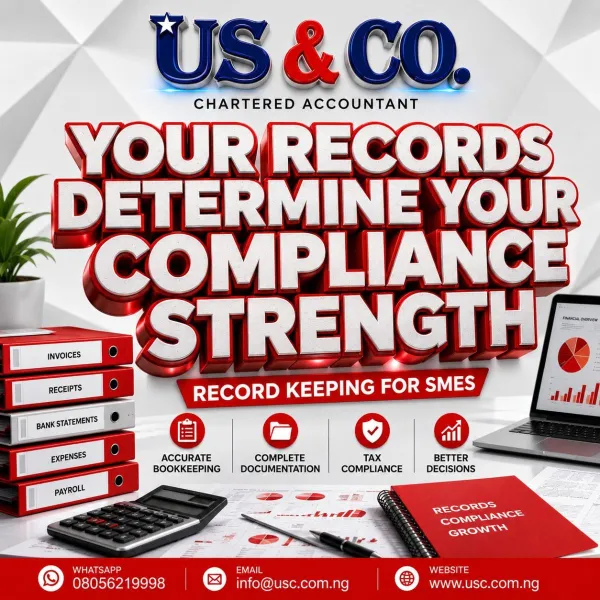
Your records determine your compliance strength.
Many Small and Medium-sized Enterprises (SMEs) focus on generating sales, serving customers, and expanding their businesses. However, one of the most important responsibilities of every business is maintaining proper accounting records and understanding the taxes applicable to its operations.
Good record keeping is more than an accounting exercise. It provides the foundation for accurate financial reporting, proper tax compliance, informed business decisions, and regulatory compliance. Without complete and reliable records, businesses may experience difficulties when preparing tax returns, responding to regulatory reviews, obtaining financing, or evaluating business performance.
This guide explains why record keeping is essential, how Nigeria's tax system operates, the major taxes applicable to businesses, practical steps for maintaining proper records, and common mistakes business owners should avoid.
What is Record Keeping?
Record keeping is the systematic process of collecting, organizing, storing, and maintaining all financial and business documents relating to a business.
Examples include:
- Sales invoices
- Purchase invoices
- Payment vouchers
- Receipts
- Bank statements
- Payroll records
- Tax payment receipts
- Tax returns
- VAT schedules
- Withholding Tax schedules
- Asset registers
- Inventory records
- Expense records
- Loan documents
- Contracts and agreements
Every transaction should be supported by appropriate documentation.
Why Record Keeping is Important for SMEs
Proper record keeping enables businesses to:
- Prepare accurate financial statements.
- Calculate taxes correctly.
- Support tax returns filed with relevant tax authorities.
- Monitor business performance.
- Manage cash flow effectively.
- Detect errors and irregularities promptly.
- Make informed business decisions.
- Meet statutory compliance requirements.
- Facilitate external audits where applicable.
- Improve credibility when applying for loans or investments.
Maintaining complete records also helps reduce disputes arising from inaccurate tax computations.
Understanding the System of Taxation in Nigeria
Nigeria operates a multi-level tax system administered by different tax authorities.
Generally, taxes are administered by:
- The Nigeria Revenue Service (NRS) for federal taxes.
- State Internal Revenue Services for certain state taxes.
- Local Government Revenue Authorities for specified local levies.
The applicable tax depends on several factors, including:
- Nature of the business
- Type of income earned
- Size of the business
- Number of employees
- Industry sector
- Applicable tax laws
Businesses are expected to understand their tax obligations and comply with statutory filing and payment requirements.
Major Types of Taxes Every Business Should Understand
1. Company Income Tax (CIT)
Company Income Tax is charged on the taxable profits of companies operating in Nigeria.
The tax is generally based on adjusted taxable profit after allowable deductions and applicable reliefs provided under tax legislation.
Businesses are expected to:
- Maintain complete accounting records.
- Prepare annual financial statements.
- Compute taxable profit.
- File annual Company Income Tax returns.
- Pay any assessed tax within statutory timelines.
Proper accounting records are essential because the tax computation is based on financial information.
2. Value Added Tax (VAT)
VAT is a consumption tax charged on the supply of taxable goods and services.
Registered businesses are generally expected to:
- Charge VAT where applicable.
- Issue proper tax invoices.
- Maintain VAT records.
- File periodic VAT returns.
- Remit VAT collected, subject to applicable input tax adjustments and the provisions of the law.
Failure to maintain proper sales and purchase records can result in inaccurate VAT reporting.
3. Pay-As-You-Earn (PAYE)
PAYE is the system used for deducting Personal Income Tax from employees' salaries.
Employers are responsible for:
- Computing employees' tax.
- Deducting tax from salaries.
- Remitting deductions to the appropriate State Internal Revenue Service.
- Maintaining payroll records.
- Filing statutory PAYE returns where required.
Payroll records should accurately reflect salaries, allowances, deductions, pension contributions, and taxes deducted.
4. Withholding Tax (WHT)
Withholding Tax is an advance deduction from qualifying payments for specified transactions.
Businesses may be required to deduct WHT from certain payments, remit the deductions to the appropriate tax authority, and issue evidence of deduction where applicable.
WHT serves as a credit against the recipient's final tax liability, subject to the applicable tax laws.
Businesses should maintain detailed schedules showing:
- Supplier names
- Nature of transaction
- Gross amount
- WHT deducted
- Date of remittance
- Evidence of payment
How Record Keeping Supports Tax Compliance
Good records make it easier to:
- Prepare tax returns accurately.
- Calculate taxable income.
- Support allowable expenses.
- Compute VAT correctly.
- Reconcile bank transactions.
- Respond to requests from tax authorities.
- Avoid duplicate entries.
- Monitor tax payments.
- Claim available tax credits where applicable.
Accurate documentation provides evidence that reported figures are based on actual business transactions.
Step-by-Step Guide to Maintaining Proper Business Records
Step 1: Open a Dedicated Business Bank Account
Separate business transactions from personal expenses.
Mixing personal and business finances makes accounting more difficult and may affect the accuracy of financial records.
Step 2: Keep Every Supporting Document
Retain:
- Receipts
- Invoices
- Contracts
- Delivery notes
- Bank statements
- Tax receipts
- Payroll records
Electronic copies may also be maintained where appropriate.
Step 3: Record Every Transaction Promptly
Income and expenses should be recorded as they occur.
Regular bookkeeping reduces the risk of omissions and errors.
Step 4: Categorize Transactions Correctly
Organize transactions into appropriate accounting categories, such as:
- Sales
- Purchases
- Operating expenses
- Payroll
- Assets
- Taxes
- Inventory
Proper classification supports accurate financial reporting and tax computation.
Step 5: Reconcile Your Records
Compare accounting records with:
- Bank statements
- Cash records
- VAT schedules
- Supplier statements
- Customer balances
Regular reconciliation helps identify discrepancies early.
Step 6: Prepare Financial Statements
Periodic preparation of financial statements enables business owners to understand profitability, financial position, and cash flow.
These reports also provide the basis for tax computations.
Step 7: File Tax Returns Within Statutory Deadlines
Timely filing demonstrates compliance with applicable tax laws and helps businesses avoid statutory consequences associated with late filing where provided by law.
Common Mistakes SMEs Should Avoid
Many tax challenges arise from avoidable record-keeping mistakes.
Examples include:
- Mixing personal and business transactions.
- Keeping incomplete accounting records.
- Losing receipts and invoices.
- Recording transactions late.
- Incorrectly classifying expenses.
- Failing to reconcile bank accounts.
- Ignoring payroll documentation.
- Keeping manual records without proper backup.
- Filing tax returns using incomplete information.
- Mixing incorrect tax definitions, such as confusing Company Income Tax with Personal Income Tax or assuming VAT and Withholding Tax serve the same purpose.
Understanding the purpose of each tax helps businesses apply the correct tax treatment.
Why Every Business Should Comply with Nigerian Tax Regulations
Tax compliance contributes to the orderly administration of the tax system and supports public revenue used for government services and infrastructure.
For businesses, compliance can also:
- Demonstrate adherence to statutory obligations.
- Reduce the risk of regulatory disputes.
- Improve financial transparency.
- Support applications for financing and investment.
- Facilitate participation in procurement processes where evidence of tax compliance may be required.
- Strengthen internal financial management.
Compliance begins with maintaining reliable accounting records.
Relevant Tax Laws Businesses Should Be Aware Of
The Nigerian tax system is governed by various tax laws and regulations, including legislation relating to:
- Company Income Tax
- Value Added Tax
- Personal Income Tax
- Withholding Tax administration
- Tax administration and procedural requirements
Businesses should ensure that their accounting records and tax filings are prepared in accordance with applicable laws and any subsequent amendments.
Understanding Tax Credits and Available Opportunities
Businesses should understand lawful opportunities available within the tax framework.
Depending on the applicable legislation and business circumstances, these may include:
- Recognition of allowable business expenses.
- Utilization of eligible tax credits where provided by law.
- Proper treatment of Withholding Tax credits.
- Reliefs available under applicable tax legislation.
- Accurate documentation supporting deductible expenses.
Businesses should maintain adequate supporting documentation before claiming any relief or credit.
Why Many Businesses Engage Professional Tax Consulting Firms
Tax compliance involves accounting standards, tax legislation, statutory deadlines, documentation requirements, and evolving regulatory guidance.
Engaging qualified professionals may assist businesses in:
- Preparing accurate financial records.
- Correctly interpreting tax laws.
- Computing taxes based on available records.
- Identifying documentation requirements.
- Reducing clerical and computational errors.
- Maintaining organised accounting systems.
- Meeting statutory filing deadlines.
- Responding appropriately to tax-related enquiries.
- Supporting internal compliance processes.
- Keeping abreast of changes in tax regulations.
Professional guidance can contribute to more reliable tax administration within a business.
Learn Your Tax Category
Every business has unique tax obligations depending on its structure, activities, turnover, workforce, and applicable tax laws.
Understanding your tax category helps you:
- Identify applicable taxes.
- Maintain appropriate records.
- Prepare accurate tax returns.
- Plan compliance activities effectively.
- Avoid unnecessary reporting errors.
Knowing your obligations is an important part of responsible business management.
Conclusion
Good record keeping is one of the strongest foundations for sustainable business management.
Accurate records support financial reporting, improve decision-making, facilitate tax compliance, and enable businesses to meet their statutory responsibilities with confidence.
As tax regulations continue to evolve, SMEs benefit from reviewing their accounting systems regularly, maintaining complete documentation, and ensuring that tax filings are supported by accurate financial information.
Where professional guidance is required, businesses may consult qualified accounting and tax professionals for assistance in understanding their obligations under applicable Nigerian tax laws.
Need Further Professional Guidance?
For businesses seeking professional assistance on accounting records, tax compliance, bookkeeping, financial reporting, or statutory filings, you may contact a Professional Tax Consulting Firm in Lagos, Nigeria.
US & CO. (Chartered Accountant)
📞 WhatsApp: 08056219998
📧 Email: info@usc.com.ng
🌐 Website: https://www.usc.com.ng
Frequently Asked Questions (FAQs)
1. What records should every SME keep?
Businesses should retain invoices, receipts, bank statements, payroll records, tax documents, contracts, inventory records, asset registers, and accounting records supporting all business transactions.
2. Why is record keeping important for tax purposes?
Proper records provide the information needed to prepare accurate tax returns, support tax computations, and maintain evidence of business transactions.
3. What are the major taxes businesses should understand in Nigeria?
The major taxes commonly encountered by many businesses include Company Income Tax (CIT), Value Added Tax (VAT), Pay-As-You-Earn (PAYE), and Withholding Tax (WHT), depending on the nature of the business and applicable legal requirements.
4. Can poor record keeping affect tax compliance?
Yes. Incomplete or inaccurate records may result in incorrect tax computations, reporting errors, and difficulties in supporting information submitted in tax returns.
5. How often should accounting records be updated?
Recording transactions promptly and reviewing records regularly helps maintain accurate financial information throughout the year.
6. How can a professional tax consultant assist a business?
A qualified tax consultant may assist with bookkeeping, tax computations, financial reporting, statutory filings, interpretation of tax legislation, and maintaining organised compliance processes.