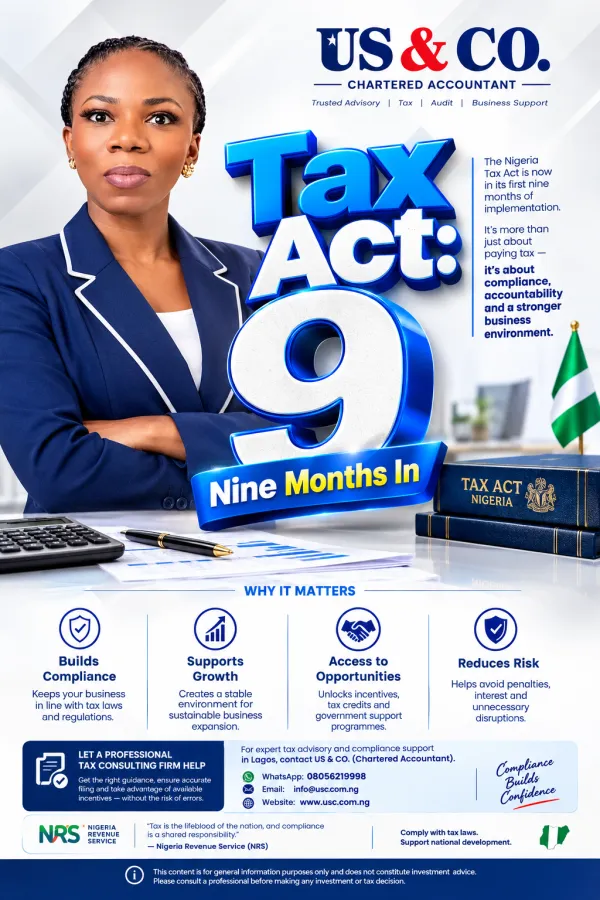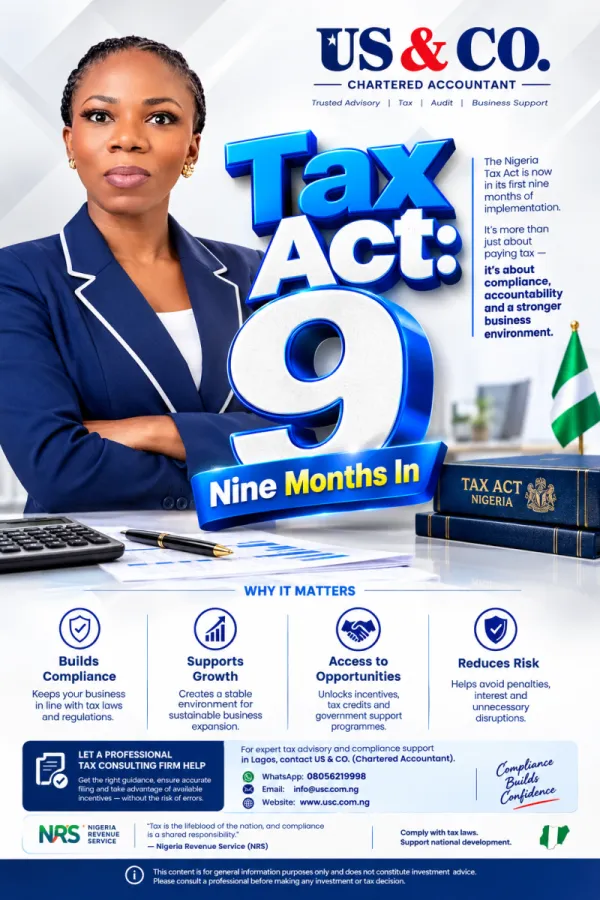
Many business owners are still working out what this means for their books, their payroll and their filing calendar. This article sets out the main points in plain terms so you can check your own position before the year closes.
What the Nigeria Tax Act does
The NTA consolidates a number of separate tax laws into one framework. It replaces, among others, the Personal Income Tax Act, the Companies Income Tax Act, the Value Added Tax Act and the Capital Gains Tax Act. The aim, as stated in public commentary on the reform, is simpler administration and a broader tax base.
For a business owner, the practical effect is that one Act now governs most of the rules you deal with, and the Nigeria Revenue Service (NRS) administers the federal side.
How it works: the main areas affecting businesses
1. Company income tax and the small company category Under the NTA, a company that meets the "small company" definition is taxed at 0% on income. Published summaries describe the test as annual gross turnover of ₦100 million or less and total fixed assets not above ₦250 million. Both conditions must be met. Some commentary notes a difference between the figures in different parts of the legislation, and certain categories of business may be excluded, so confirm your status before relying on it.
Companies outside this category are subject to income tax at the rate set out in the Act (30% is the figure cited in most published guides).
2. The Development Levy A 4% Development Levy on assessable profit applies to companies that are not small companies. It consolidates the Tertiary Education Tax, the NITDA levy, the NASENI levy and the Police Trust Fund levy into one charge.
3. Value Added Tax (VAT) VAT remains at 7.5%. Published guides note that the reformed rules widen the recovery of input VAT on purchases, including services and fixed assets, subject to the conditions in the Act. Businesses should keep valid tax invoices to support any claim.
4. Capital gains Gains of companies are taxed at the company rate, and individuals' gains are assessed under personal income tax rates. Gains on digital and virtual assets are also brought within the tax net.
5. Digital administration The NRS has introduced Rev360, an online platform for registration, filing, payments, tax clearance, refunds and e-invoicing. Tax IDs are linked to identity records held by CAC (for companies) and NIMC (for individuals).
What the NRS says
The NRS describes itself as the authority established to "assess, collect, account for, and enforce all federally collectible taxes" in Nigeria, replacing the Federal Inland Revenue Service. Its website (nrs.gov.ng) lists the Nigeria Tax Act, 2025, the Nigeria Tax Administration Act, 2025 and the NRS (Establishment) Act, 2025 under its tax laws section, alongside guidance on tax returns, forms, the tax calendar and penalties.
Why this matters to taxpayers
A change of law affects more than the tax rate. It changes which forms apply, how records are expected to be kept, and what evidence supports a claim. A business that qualified for a relief under the old rules may not qualify now, and the reverse can also be true. Reviewing your position now, while there are still months left in the year, leaves time to correct issues before returns fall due.
Tax implications to consider
- Zero-rated income tax is not zero compliance. Published guidance states that small companies still need a Tax ID, proper records and annual returns, even where no income tax is due.
- The Development Levy is charged on assessable profit, so classification as a small or non-small company changes the total tax cost.
- PAYE, VAT and withholding tax obligations continue regardless of company size.
- Records. Bank statements, invoices and payment platform reports are increasingly the evidence tax authorities rely on.
Step by step: how to review your position before year-end
- Confirm your classification. Compare your turnover and fixed assets against the small company definition in the Act.
- Verify your registration. Check that your Tax ID and company details on the NRS portal match CAC records.
- Reconcile your records. Match the ledger to bank statements, POS reports and invoices.
- Review VAT. Confirm that you charge and account for VAT correctly and hold invoices for input VAT.
- Review payroll. Check that PAYE is calculated under the current bands and remitted on time.
- Map your calendar. List filing and payment dates for VAT, PAYE, withholding tax and annual returns.
- Document your decisions. Keep written support for any position taken on classification or deductions.
Why engage a professional consulting firm
Tax reform creates areas where interpretation matters. A qualified accountant can help in the following ways:
- Accuracy. Computations are checked against the current law, which reduces the risk of errors and resulting penalties.
- Classification. Assessing whether a business meets the small company test, including where legislation or guidance differs.
- Documentation. Preparing records that support your filings if the NRS raises a query.
- Timing. Keeping filing and payment dates under review so nothing is missed.
- Independence. An external review offers a second view of your own figures.
Why every business should comply
Compliance is a legal obligation, and it also supports the business itself. Accurate filings help when applying for tax clearance certificates, bidding for contracts, opening credit facilities and preparing audited financial statements. Non-compliance can result in penalties, interest and enforcement action under the tax laws.
Tips on reliefs and opportunities
- Keep a clear record of allowable business expenses, since only properly supported deductions can be claimed.
- Review capital allowance claims on qualifying assets.
- Where eligible, review incentives available to specific sectors and to startups under the relevant legislation.
- Keep input VAT invoices organised for recovery.
- Check whether your business qualifies for small company treatment and apply it correctly.
Relevant laws
- Nigeria Tax Act, 2025
- Nigeria Tax Administration Act, 2025
- Nigeria Revenue Service (Establishment) Act, 2025
- Joint Revenue Board (Establishment) Act, 2025
Frequently asked questions
Does a 0% company income tax rate mean I do not need to file? No. Published guidance states that small companies still need a Tax ID, records and annual returns.
Which body do I deal with for company income tax and VAT? The Nigeria Revenue Service handles federal taxes, including company income tax, VAT and withholding tax.
Is the Development Levy an additional tax? It replaces several earlier levies with a single 4% charge on assessable profit for companies outside the small company category.
Where can I read the law? The Acts are listed on the NRS website at https://www.nrs.gov.ng under tax laws.
When should I review my position? A review before year-end leaves time to correct errors and plan for filing.
Where you need further assistance: You may contact US & CO. (Chartered Accountant), a professional tax consulting firm in Lagos, Nigeria. 📞 WhatsApp: 08056219998 📧 Email: info@usc.com.ng 🌐 Website: https://www.usc.com.ng
Footnote: This article is for general information only. It is not complete investment, tax or legal advice. Rates, thresholds and deadlines may change, so readers should consult a qualified professional and check current NRS guidance before making any investment or tax decision.