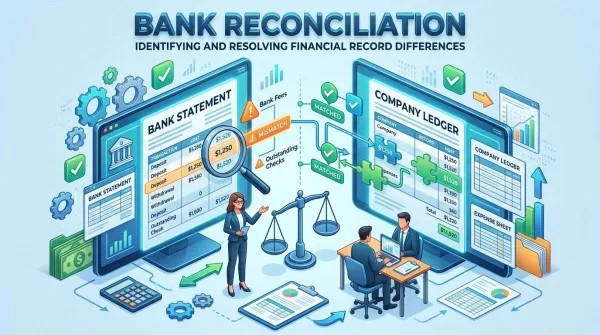
Bank Reconciliation: Identifying and Resolving Financial Record Differences
Does your business's accounting records always agree with the balance shown on its bank statement?
For many businesses, differences between accounting records and bank statements are common. However, when these differences are not properly investigated, they can affect the accuracy of financial reports and create difficulties in managing cash.
One important accounting procedure that helps address this issue is bank reconciliation.
What Is Bank Reconciliation?
Bank reconciliation is the process of comparing the cash balance recorded in a business's accounting records with the balance shown on its bank statement.
The purpose is to identify, investigate and explain differences between the two balances so that the business can establish an accurate cash position.
It is an important part of financial record-keeping and internal control.
Why Do Bank Balances Differ?
Differences between bank statements and accounting records may arise for several reasons.
1. Outstanding Cheques
These are cheques issued and recorded by a business but not yet presented to the bank for payment.
2. Deposits in Transit
These are amounts already recorded by the business but not yet reflected in the bank statement.
3. Bank Charges
Banks may deduct service charges, transaction fees and other applicable expenses that the business has not yet recorded.
4. Direct Deposits
Customers or other parties may transfer money directly into the business's bank account without immediate notification to the accounting department.
5. Standing Orders and Direct Debits
Automatic payments may be processed by the bank before the business updates its accounting records.
6. Recording Errors
Differences may also result from incorrect amounts, duplicated transactions or transactions recorded in the wrong accounts.
Steps in Preparing a Bank Reconciliation Statement
Businesses can follow these procedures:
Step 1: Obtain the Bank Statement
Collect the bank statement for the period being reconciled.
Step 2: Review the Cash Book
Examine the business's cash book or bank ledger to establish the recorded balance.
Step 3: Compare Transactions
Match deposits, withdrawals, transfers and other transactions against the bank statement.
Step 4: Identify Differences
List outstanding cheques, deposits in transit, bank charges and other reconciling items.
Step 5: Investigate Errors
Review unusual differences and obtain supporting documents where necessary.
Step 6: Update Accounting Records
Record necessary adjustments for transactions such as bank charges, direct debits and interest received.
Step 7: Confirm the Reconciled Balance
Ensure that the adjusted balances agree after all relevant reconciling items have been considered.
Practical Example
Assume a business has the following balances:
- Cash book balance: ₦850,000
- Outstanding cheques: ₦100,000
- Deposits in transit: ₦50,000
The adjusted bank statement balance is:
Bank statement balance + Deposits in transit − Outstanding cheques.
Assuming the bank statement balance is ₦900,000:
₦900,000 + ₦50,000 − ₦100,000 = ₦850,000.
The adjusted bank statement balance is therefore ₦850,000, agreeing with the cash book balance in this simplified example.
Why Is Bank Reconciliation Important?
Improves Financial Accuracy: It helps identify differences that could otherwise distort accounting records.
Detects Unauthorised Transactions: Regular reconciliation can help reveal unfamiliar or suspicious withdrawals and payments.
Strengthens Internal Controls: It supports accountability and independent review of cash transactions.
Improves Cash Management: Management gains a clearer understanding of available bank balances and outstanding transactions.
Supports Financial Reporting: Accurate cash records contribute to reliable financial statements.
Common Bank Reconciliation Mistakes
Some businesses reconcile their accounts irregularly, ignore unexplained differences or fail to investigate old outstanding transactions.
Others allow the same employee to initiate payments, record transactions and independently approve reconciliations. This can weaken internal controls.
Businesses should establish clear responsibilities and ensure that reconciliations are reviewed by an appropriate person.
Conclusion
Bank reconciliation is more than comparing two financial balances. It is an important accounting control that helps businesses maintain accurate cash records, identify irregularities and improve financial accountability.
Regular bank reconciliation enables management to make decisions using more reliable financial information.
US & CO. Chartered Accountant
Educational insights into accounting, financial reporting and effective business management.
