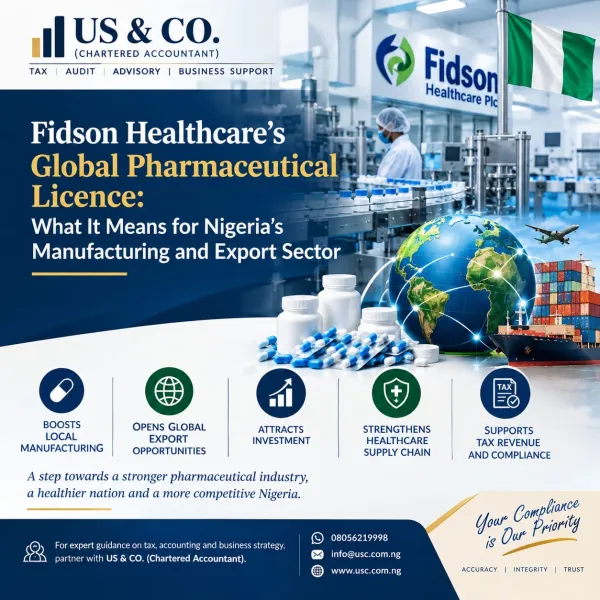
Nigerian pharmaceutical manufacturer Fidson Healthcare Plc has been selected, alongsideten other manufacturers across nine countries, as a sublicensee under a voluntary licensingagreement between the
Medicines Patent Pool (MPP)
and
Roche
, to develop andmanufacture a generic version of
baloxavir marboxil
, an antiviral used in the treatment ofinfluenza. The announcement, made public around 25 September 2026, places a Nigeriancompany inside a global supply arrangement spanning 129 countries. This article looks atwhat the development involves, and why it is worth attention from a business and complianceperspective, even for readers outside the pharmaceutical sector.
How this kind of licensing arrangement works
A voluntary licence of this kind allows a patent holder, in this case Roche, to authorise selectedmanufacturers to produce and supply a generic version of a patented medicine, typicallyacross a defined list of countries and subject to conditions. The Medicines Patent Pool, a UnitedNations-backed organisation, negotiates and administers such agreements, with the statedaim of diversifying global manufacturing capacity and supply.
Selection as a sublicensee is not, by itself, authorisation to sell. According to availablereporting, selected manufacturers such as Fidson receive technical data and access to thereference product for bioequivalence studies, as part of a development process that stillrequires
regulatory approval in each market
before any product reaches patients. In Nigeria,that would mean approval from the National Agency for Food and Drug Administration andControl (NAFDAC), in line with the country's existing pharmaceutical regulatory framework.
Why this matters, beyond the pharmaceutical sector
For a Nigerian business audience, this development is a useful illustration of a broaderprinciple:
access to a global opportunity is only the first step; the capacity to meet thecompliance standard attached to it is what converts that access into actual business.
Fidson's selection reportedly followed an Expression of Interest process in which the MPPassessed manufacturers' technical and regulatory capacity, not merely their expression ofinterest.
This mirrors a pattern seen across many regulated and export-oriented sectors in Nigeria,including businesses working toward export readiness under various government andmultilateral trade initiatives: the opportunity to participate in global markets exists, but it isearned through demonstrated compliance, proper documentation, and consistent quality orregulatory standards, not assumed.
What it may signal for Nigeria's manufacturing and export sector
A data point for manufacturing credibility.
A Nigerian-based manufacturer beingassessed and selected alongside companies from India, China, Brazil, Indonesia andMalaysia is a reference point for the kind of manufacturing standard Nigerianpharmaceutical companies are being evaluated against on the global stage.
A reminder that regulatory approval remains a separate, necessary step.
Beingselected for a licence does not equal approval to manufacture or sell; NAFDAC and otherregulatory processes would still need to be satisfied before any product reaches theNigerian or export market.
A potential example for other sectors.
Businesses in agro-processing, textiles, and otherexport-oriented industries can draw a parallel: global supply chain participationincreasingly depends on documented compliance capacity, not simply lower costs orlocal production capability alone.
Relevance to business compliance generally
While this is not, strictly speaking, a tax development, the underlying lesson is one thatapplies directly to tax and regulatory compliance for any Nigerian business with export ormultinational ambitions:
Documentation and verifiable records
are often the deciding factor in whether abusiness qualifies for an opportunity, whether that is a pharmaceutical sublicence, anexport credit facility, or, closer to home, a business's own tax clearance certificate andgood standing with the Nigeria Revenue Service.
Consistent standards, maintained over time
, rather than a one-time compliance effort,tend to be what regulators and global partners actually assess.
Businesses preparing for export or international partnerships
should treat theirregulatory, financial and tax compliance records as part of their overall readiness, not aseparate administrative task.
Step by step: what Nigerian businesses can take from this example
1.
Review your own sector's international compliance benchmarks
, whether regulatory,quality, or financial, and assess your current standing against them.
2.
Maintain documentation discipline
as a matter of course, not only when an opportunityarises, since assessments often look at a track record rather than a point-in-timesubmission.
3.
Keep your tax and regulatory filings current
, as these frequently form part of duediligence in partnership, licensing, or export processes.
4.
Engage relevant regulators early
, whether NAFDAC for pharmaceutical products or theNRS for tax standing, rather than only at the point an opportunity is secured.
5.
Treat compliance as a competitive asset
, not merely a cost of doing business.
Why this is relevant to how US & CO. supports businesses
Whatever a business's sector, the principle illustrated by Fidson's selection holds: credibleopportunities, whether global licensing arrangements or domestic growth, tend to go tobusinesses that can demonstrate clean, consistent compliance, including accurate financialand tax records. Businesses preparing for growth, partnership or export should treat theiraccounting and tax position as part of that readiness.
Frequently asked questions
Has Fidson received a licence to sell its product internationally?
Based on availablereporting, Fidson has been selected as a sublicensee to develop and manufacture a genericversion of baloxavir marboxil. Actual manufacturing and sale would still require regulatoryapproval in each relevant market.
What is baloxavir marboxil?
It is an antiviral medicine used in the treatment of influenza,originally developed and patented by Roche.
What is the Medicines Patent Pool?
A United Nations-backed organisation that negotiatesvoluntary licensing agreements to expand access to and manufacturing of certain medicines.
Does this mean Fidson products will be sold in 129 countries immediately?
No. The licencecovers potential supply to 129 countries, but actual market entry in each would depend onseparate regulatory authorisation.
Why is a tax and accounting firm writing about this?
The underlying lesson, thatdocumented, consistent compliance is often what converts an opportunity into a real outcome,applies directly to the regulatory and tax readiness every growing Nigerian business needs.
Sources:
Nigerian drugmaker Fidson selected to manufacture generic influenza antiviral underglobal licence — Premium Times
Fidson, 10 others get licence to produce generic influenza drug — The Guardian Nigeria
Nigerian Drugmaker Fidson Selected to Manufacture Generic Influenza Antiviral UnderGlobal Licence — allAfrica
Fidson Selected for Global Licence to Manufacture Roche Influenza Antiviral —Pharmacy Times Nigeria
Where you need further assistance:
You may contact US & CO. (Chartered Accountant), aprofessional tax consulting firm in Lagos, Nigeria. 📞 WhatsApp: 08056219998 📧 Email:
info@usc.com.ng
🌐 Website:
https://www.usc.com.ng
Footnote: This article is for general information only, based on publicly reported news at thetime of writing. It is not complete investment, tax or legal advice, and makes norecommendation regarding Fidson Healthcare or any security. Readers should consult aqualified professional and verify current developments before making any investment orbusiness decision.